In Robert Eggers’ Nosferatu, a girl can finally have it all.
I like Rober Eggers quite a lot. His first feature The VVitch is a gripping period piece with one of the most accurate and terrifying depictions of the Devil and his machinations found in film. The Northman is a beautiful and intense revenge story, with all the Hamletian treachery and personal intrigue one could hope for alongside some brutal depictions of 9th century Norse life. The Lighthouse, probably his worst film, is still pretty good, riding the phenomenal performances of Willem Defoe and Robert Pattinson as the latter becomes increasingly unhinged. Eggers gets some flack for leaning so heavily into the “assume the Puritans/Vikings/etc. were ontologically correct” tool for creating his worlds, but he uses it to masterful effect. These past successes made me very excited to see his take on Nosferatu: Eggers being unleashed on potentially the gothic horror story, with a budget to make his vision a reality? What’s not to like?
It turns out the answer is “not much.” The film is wonderful, well-paced, campy when needed, drenched in dread, and quite bold in its depictions of self-destruction, narcissistic helplessness, and the vanity of certainty. The cast is solid through-and-through, with Lily Rose Depp and Ralph Ineson delivering particularly strong performances as the lead Ellen and her doctor Wilhelm Sievers, respectively. Its slow pacing somehow fails to drag over the 2+ hour runtime, while doing a good job to really steep you in just how much is really happening across the film’s temporal scope. It is a great watch – definitely one of the best of 2024 – but what makes it stand out in the Eggers canon is not just its stylistic achievements, but its completion of the director’s ongoing wrestling with the question of want and if we can ever really get the things we ask for.
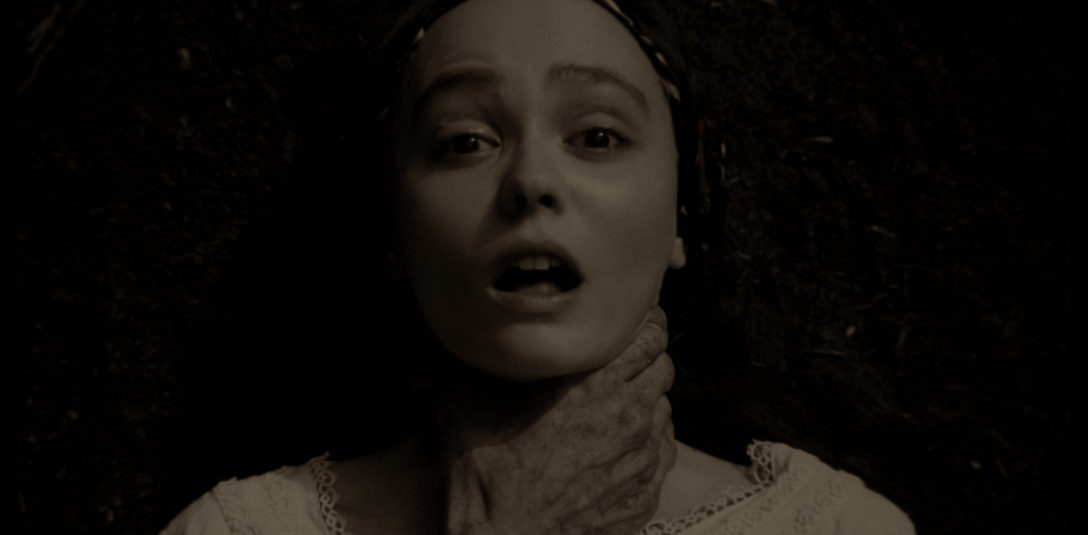
Nosferatu begins with a striking image: an extreme close-up of a weeping Ellen crying out, “Come to me. Come to me! A guardian angel, a spirit of comfort – spirit of any celestial sphere – anything – hear my call!” She is quickly joined by a disembodied voice, initially speaking an unknown language, before leading her from bed – first levitating, then sleepwalking – and saying “You are not for the living. You are not for human kind . . . And shall you be one with me ever-eternally? Do you swear it?” to which Ellen eagerly responds, “I swear.” She seemingly collapses, and we sense this force entering her in some way. She writhes in pleasure which quickly turns to pain before experiencing a violent seizure which persists until the title card. It’s an arresting opening scene, and one which concisely lays out how Ellen got herself into this whole mess. She wanted. She cried out in want. And someone answered.
The film continues with Ellen waking from a nightmare – the first of many she will have – searching for her new husband, Thomas, who quickly informs her that he has to leave for an appointment with a prospective employer. Thomas, played by the sweaty and gullible Nicholas Hoult, leaves to meet with the real estate mogul Herr Knock. Knock gives him a 6-week assignment to sell a decrepit castle in their hometown of Wisborg to one Count Orlock, an old-blood aristocrat who wants to relocate from his home in Transylvania. Of course, the contract which Thomas goes to fulfill is actually an occult ritual to sell his precious Ellen to her first, immortal, immaterial husband. But more on that later.
Thomas makes the difficult trip to Orlock’s castle, ignoring the (objectively correct) cries of the local Gypsies to avoid the beast at the end of his journey, fulfilling Orlock’s ultimate wish by unknowingly signing over his wife for a sack of gold. He is quickly rewarded by having blood sucked directly from his chest, being chased by wolves, facing down a nude (and flaccid) Orlock, and falling off of a castle ledge into the icy river below, only to be miraculously rescued by a group of extremely patient Orthodox nuns. I hate to say that a vampire’s victim deserved their fate, but at a certain point, there are only so many warning signs one can ignore before basically asking to be phlebotomized.
During Thomas’ absence, Ellen descends into an extreme state of melancholia punctuated with nightly seizures and hallucinations. Eventually, Dr. Sievers – having run out of ideas of how to help the girl – asks his former mentor, Dr. Albin Eberhart von Franz (played by a clearly delighted Willem Defoe), for help. Von Franz is a brilliant scientist run out of his native Switzerland for his unrelenting want of more knowledge which led him into the arcane and occult, and he takes to his new task with great verve. He meets with the girl briefly to discuss her case, and that night completes some sort of pseudo-exorcism to force Ellen’s channeling of that force within her, getting its first direct message: “I shall persist to join you every night, first in sleep, then in your arms. Everything will be mixed with abomination, and you’ll be knee-deep in blood. Everyone will cry. There will be none to bury the dead.” Von Franz is almost stricken with glee at the confirmation that a possession has taken place, and the race against Orlock begins.
What follows is a series of tragedies, wherein Ellen plays a game of will-they-won’t-they with the recently arrived Orlock, who (bringing with him a boat full of plague rats) promises ruin if Ellen does not agree to their binding. Ellen tries to spite him by having sex with her husband, which Orlock rewards by murdering her host Freidrich’s wife Anna and two young daughters. In response, von Franz leads Thomas (recently returned and dense as ever), Sievel, and an uncharacteristically calm Ellen on a two-sided attempt to trap the vampire: the men believing they are to slay the beast in an act of knight-like herosim, and Ellen knowing that she is actually to welcome Orlock into her bed, keeping him there until sunrise, sacrificing herself to save the others. Friedrich dies, Thomas and Sievel join the giddy von Franz to destroy Orlock’s coffin, and Ellen offers herself back to the villain, allowing him to drink so deeply from her that she dies alongside (or, rather, underneath) the shriveled demon in the morning light. Wisborg is saved, the vampire is killed, and Ellen’s teenage ask for a companion only ends up costing a few thousand lives. All is well.
The underlying story of Nosferatu is, honestly, quite ridiculous, and Eggers does a good job of playing with this. Defoe provides by far the funniest performance, really leaning into some of the camp inherent in the actions being taken – dancing in the fire of a room full of burning rats, ending the film with a shot of his reflection in a mirror holding (the freshly deceased) Ellen’s cat as the sun rises, and being honestly surprised at the shock of the others when his ring-to-the-forehead exorcist routine sparks a demonic exultation from Ellen. Thankfully, other characters get their opportunities to play as well: the slow-pan above the mid-coitus, literally hysterical, babbling Ellen’s face in the room where she reveals her secret to Thomas comes to mind, alongside the scene where the fully insane Herr Knock bites the head off of a live pigeon only to receive an exasperated “Now, my good fellow, why would you do that?” from Sievers. The movie is not a comedy, but it is not afraid to play with the ridiculous, and it is greatly improved for doing so. It is a feat of tone and form that really deserves the praise it’s been getting.
As was mentioned, though, it is not in its comedy or aesthetics that Nosferatu really shines. It is in its depictions of the inherent grappling one does with their wants – both noble and ignoble – and in its willingness to depict what can happen if one truly gets everything they want.
Ellen, as the protagonist, is the obvious vessel for these themes, but there is a real beauty in her story as a woman facing down her wants and their consequences that can be lost if we view her simply as someone who made a “bad” choice and is now facing consequences. She is not some pure, spotless victim. She is not a victim at all – she is a woman who made choices, and those choices have led her here, and now more choices must be made. At one point, recounting the growth of her relationship with Orlock, Ellen tells of how her connection to the supernatural started in youth, manifesting in ways she readily welcomed (like the ability to foresee Christmas presents), before leading to the ask that would define her life:
But as I became older it worsened… Father dispraised me for it… I frightened him. My touch. I was so very alone, you see and… I wished for comfort… then a presence… and the nightmares, the epilepsies… I… At last Papa found me once laying…unclothed, I was… my body… my flesh… my… Sin, sin, he said… He would have sent me to someplace… I shan’t go… I – It all ended when first I met my Thomas. From our love, I became as normal. Professor… My dreams grow darker, they sicken me. Does evil come from within us or from beyond?
Later, when discussing his prognosis (that is, of course, demonic possession), von Franz explains a bit about why he thinks Ellen has fallen prey to this force. The conversation is telling, and I think worth quoting in full:
VON FRANZ: The dear young creature is obsessed of some spirit … perhaps some daemon.
HARDING: I beg your pardon?
SIEVERS: I assure you, Harding, the good professor means this as hyperbole.
VON FRANZ: No, I mean a daemon.
HARDING: You jest–
SIEVERS: What of your discovery of macabre hallucination pathologies–
VON FRANZ: This is not one!
HARDING: You scarcely looked at her!
ANNA: How should this happen to Ellen?
VON FRANZ: Daemonic spirits more easily obsess those whose lower animal functions dominate. Daemons like them, they seek them out.
ANNA: How mean you?
VON FRANZ: They can discover their victims from across mountains, great oceans…
SIEVERS: Those with lower animal funct- ?
ON FRANZ: Yes. Hysterics, children, lunatics . . . Somnambulists afflicted with these perversions oft possess a gift: a second sight into the borderland.
SIEVERS: I do not wish to dispute you, yet, I have myself seen women of nervous constitutions invent any manor of delusion.
VON FRANZ: This is no delusion. I believe she has always been highly conductive to these cosmic forces, uniquely so.
These scenes seem almost designed to bait the audience into pseudo-feminist theorizing around what the “lower animal functions” being described actually are. I have been glad to see that mainstream commentary on the film avoids the trap of saying “lower animal functions = sexual desire,” but I do think viewers miss out on much of what makes Ellen who she is if it is brushed past as outdated psuedoscience. This “lower animal function” that Ellen possesses is not incidental or something she is victim to. It is what made her open to Orlock’s embrace in the first place. It is not about being a sexual being – it is about being a person who, for her whole life, has been intense in all things, and particularly her wants.
Like a child, or like a hysteric, Ellen has always acted (consciously and unconsciously) in elevated states of being, entirely fixated on particular wants, with an assumption of annihilation if they were not fulfilled. We see it in her bouts of sleepwalking masturbation and the all-encompassing loneliness that made her willing to welcome “a spirit of any celestial sphere” into her, not to mention her extreme melancholia and near pathological need to be accompanied by a lover (preferably Thomas, or begrudgingly Orlock). She needs in all her desires the most complete version of the thing, and it leads her again and again into places those less attuned to the otherworldly could never imagine going.
The film makes it clear that Ellen is suffering for succumbing to these extreme states of want, but it also makes it clear that she is not bad for this. The film understands that sometimes good people suffer greatly from wanting understandable things, and that this suffering can be exactly what they are asking for. In a particularly touching scene, shortly before her death, Ellen tells von Franz “His pull on me is so terrible, so powerful – yet my spirit cannot be evil as his . . . I need no salvation. My entire life I have done no ill but heed my nature.” Von Franz, the only person who can accept all that Ellen is, responds: “In heathen times you might have been a great priestess of Isis. Yet, in this strange and modern world your purpose is of greater worth.” There is no evil in Ellen – there is simply intense, otherworldly desire for things, and a distinctly non-Victorian drive to actually ask for them.
Orlock serves as Ellen’s mirror in this, exhibiting an all-encompassing, self-destructive need for a lover. But unlike Ellen, Orlock’s wanting (or at least its outcome) is clearly malicious. He longs so much for someone to be with, to receive him in their arms, that he is willing to unleash a literal plague. Ellen wanted “anything” to come to her, and Orlock sought out anyone willing to receive him. Her want did not spawn his want, nor does it justify his actions, but her want did literally invite a response of cosmic magnitude. And, despite her protestations throughout, it is clear that what Ellen wants at her core is not really Thomas. But it is not Orlock, either. It is a want to be the prime object of want, to be so fully desired or loved by another being that they – like her – are willing to open themselves up to her, infinitely, to allow themselves to be together. She wants to be wanted with the same intensity felt in her teenage self, crying out for companionship, welcoming the void if it promised to fill her. Unfortunately, Thomas is only a man, so her emptiness and voracity can never be sated by what he has to offer. And Orlock, as a fundamentally selfish lover, also fails to provide all that she lacks. She needs something that can take her entirely, and that comes not from her marriage or her time with the vampire but from her ultimate fulfillment in a life-ending embrace. In life, Ellen was empty. In death, she is filled at once with the “love” of the predator, the love of love lost, the love of understanding, and the love of pity. By welcoming what she asked for, she becomes Ellen, Full of Love, Desired is She among Women. She is not punished for her desires. She received the most complete version possible of what she wanted and consciously accepted that sometimes what we want most has consequences.
Ellen is Egger’s success at creating someone who truly got everything they wanted. But, as if to make clear that Ellen is not unique in wanting things that aren’t exactly good for her, he weaves in other stories of want and longing with various effects, particularly through Thomas and von Franz as they gravitate towards Ellen largely out of their own need to pursue their basest wants, even if those wants are more “noble.”
Thomas is a man entirely fixed on one thing – being a good husband. It is a properly Victorian desire, but just because it is socially accepted, that does not make it good or healthy. His credulity verges on painful throughout the film, and his immediately contradictory need to provide and total fear of disappointing his wife make him unable to sense the darkness overtaking her, leading to an almost willing blindness to Orlock’s tricks. He wants so badly to be like his friend Freidrich, who can clearly fulfill the material and matrimonial needs of his wife, living in a lavish house with his continuously growing family. He completely ignores Ellen’s clear understanding of what must be done to kill Orlock, falling for von Franz’s ploy to go on a false vampire hunt. The only scene where we see any real discontent from Thomas towards Ellen happens when she basically calls him a cuck. Seemingly overtaken by Orlock, she tears her room apart before pathetically crawling over to him and putting her face to his groin, whispering “Please. I’ll be good, I’ll be good . . . You could never please me as he could.” Thomas responds to this ultimate slight against what he has tried to be quite simply: by having sex with her. It’s ridiculous but it shows just how single-minded he is in pursuing his want, and the ways a noble want can easily be twisted towards evil.
Von Franz, conversely, appears at first to be a man whose want is entirely selfish – he wants to observe Ellen and learn from her because he has reached the end of his studies’ potential without a living specimen. His initial drive towards helping the girl is entirely clinical, as seen in his experiments at Ellen’s expense (including piercing her wrist with a needle) meant to confirm his hypothesis to those doubting him in the room. Yet, as time goes on, that want is also warped, but away from self-satisfaction and towards knowing love for another. His desire is rooted in understanding the Nosferatu, and it turns out that the only way to do this is to understand Ellen. In his attempt to understand, he gives Ellen her only truly present companion – one who is willing to listen to her in everything she says, take her seriously, and work to help her with what she needs rather than what he thinks she needs.
This theme is one that Eggers has explored throughout his films, but never as completely as in Nosferatu. The Northman is obviously all about want, with the story being a revenge plot revenge spawned from a fraternal betrayal born out of a longing for power and position. The Lighthouse swirls around the homoerotic relationship between Defoe and Pattinson, the latter of which so badly craves both paternal embrace and sexual release that he becomes hierophilically fixated on a scrimshaw carving of a mermaid, beats the unloving Defoe to near death, and looks so deeply into the Holy Grail of the lighthouse’s Fresnel lens that he fully loses his mind.
The VVitch’s comes the closest to Nosferatu in really letting someone get what they want, but relies on Anya Taylor Joy’s put-upon leading woman Thomasin experiencing weeks of psychological terror culminating in the death of her entire family, setting her up for a terrifying negotiation with the Devil, disguised as the family goat, Black Phillip. She is not a woman who lives into her wants like Ellen, but she falls victim to the temptation one faces when they, broken beyond comprehension, are offered something they’ve never had:
THOMASIN: (whispers) Black Phillip. I conjure thee to speak. Speak as thou dost speak to Jonas and Mercy… Dost thou understand my English tongue?
(Silence)
BLACK PHILLIP (offscreen): What dost thou want?
THOMASIN: What canst thou give?
BLACK PHILLIP: Wouldst thou like the taste of butter? A pretty dress? Wouldst thou like to live, deliciously?.
THOMASIN: …Yes.
BLACK PHILLIP: Wouldst thou like to see the world?
THOMASIN: What will you from me?
BLACK PHILLIP: Dost thou see a book before thee?
THOMASIN: I cannot write my name.
BLACK PHILLIP: I will guide thy hand.
Ultimately, more than just being a great movie, Nosferatu is the completion of an arc Eggers began in colonial New England, weaving throughout lives and times, centered on want and all its implications. And while it can feel like Eggers leans almost too heavily on folklore and historical accuracy at times, I think what he does with them is important in a time seemingly disconnected from the logics of the past. In this age of ultimate reason, free from superstitions and where the decisions we make about the way we live and how we use our bodies are apparently entirely our own, we open ourselves up to our own dark, our own melancholies, our own sicknesses. I applaud Eggers for being willing to take our nature to task on film and am just grateful that the dressing-down is as good as Nosferatu is.
 Jitter