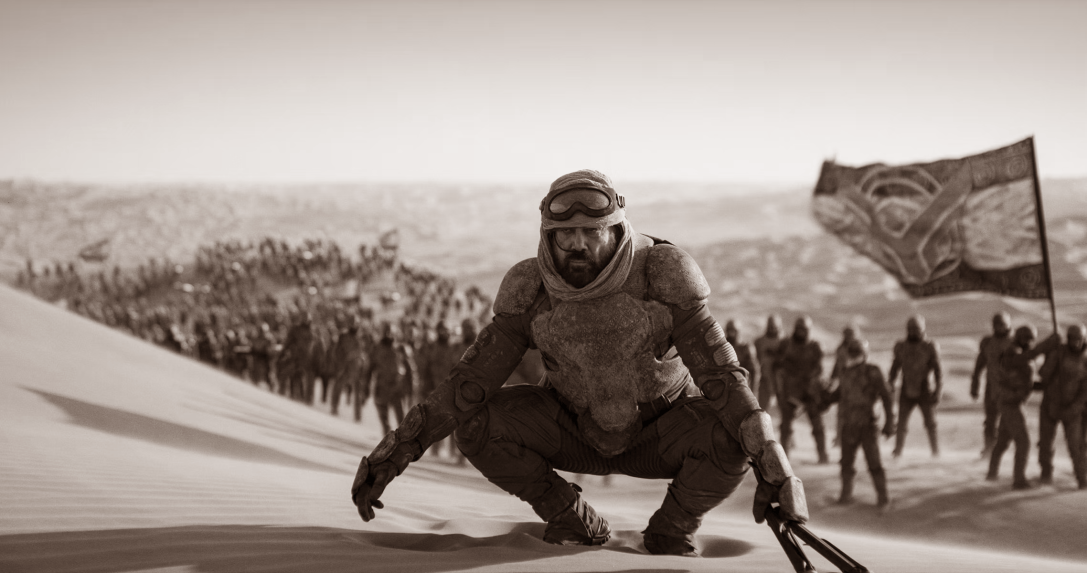
Reflexive Secularism and the Moderating of Dune
“God created Arrakis to train the faithful.”
from “The Wisdom of Muad’Dib” by the Princess Irulan
Dune Part 1 and Part 2 have received a lot of justified praise for what they offered mainstream moviegoers. A (mostly) faithful adaptation of a cherished book? A science fiction series that isn’t a reboot or spinoff of another movie series? A high-budget action movie with original world design and (mostly) intelligent storytelling? What more could fans of Herbert’s work have asked for? It seems Villeneuve finally succeeded where numerous other filmmakers had failed.
For all its great successes, though, the duology suffers from one defect that plagues much of contemporary cinema and is fatal for adapting a work like Dune: a reflexive secularism that makes filmmakers incapable of engaging with a religious world on its own terms.
Kwisatz Haderach and the Realness of Religion
Two things become clear about Frank Herbert after reading his novel:1 he had a near obsession with the aesthetics of religion (especially Catholicism, Islam, and Hinduism), and he had a skepticism of religion bordering on outright opposition. This is so obvious as to be almost unworthy of mentioning: if the centrality of the Orange Catholic Bible and Zensunni Buddislam didn’t make his fixations clear, then the tale of pseudo-Jesuit witches using missionaries to control an indigenous population anxiously awaiting a messiah to lead them in jihad ought to do the trick. And throughout the entire beautiful expansion of religion in this world, Herbert does not do much to hide his negative feelings about religion and the harm it causes to civil society.2
Dune the novel is undeniably critical of religion, but what it is not is irreligious. The world of Paul Atreides, with its decamillennium of religious growth, its Missionaria Protectiva, and its galactic ecumenical councils is anything but secular. The Fremen, while explicitly manipulated by Paul and Lady Jessica, are legitimately zealous in their religious belief and their prophetic fervor. The Kwisatz Haderach, despite having been manufactured by the Bene Geserit to further their aims, does in fact exist in the nearly-superhuman Paul. Are Paul’s visions of the future any less real because he was bred by witches to have them? Is the functional mind control that Lady Jessica and the rest of her matriarchs exert not real because it came about through intense training? Is Alia’s in uetro transformation any less miraculous because we know where the poison that caused it was sourced?
According to the book, no — these people and phenomena are literally real, and while their origins may be known, it doesn’t make them any less magical when compared to the world of the reader. And this tension is part of their beauty. To paraphrase the Reverend Mother Gaius Helen Mohiam, these mysteries are not problems to solve, but realities to experience. We don’t need to see the Fremen scoffing at religion to make it clear that the work done to turn Paul Atreides into Paul Maud’Dib was less than benevolent. We don’t need our protagonist to be surprised by the fervor of his followers to make clear that the fervor is not wholly organic. And we don’t need a character to give us an out from religion being real because the book trusts its readers to know that real and good can be separate things. But this is where Herbert and Villeneuve diverge.
Sacrificing Religion on the Altar of Seriousness
It is incredibly boring (and honestly unfair) to criticize a movie just because it differs from its source material. Of course the movie is different from the book — one is a movie and one is a book. They serve different purposes, have different capacities, and operate on different aesthetic levels. That does not mean that one is better than the other, but they are different. And it is entirely fair to evaluate them as separate texts for this reason.
At the same time, it is also legitimate to see how a movie differs from the book it is based on, and to make judgments as to whether those decisions make for a better or worse story. When it comes to intentional changes, I think Part 1 and Part 2 actually do a pretty good job at making cuts and adjustments that often improve the film viewing experience from what a more “faithful” adaptation might’ve brought. Some of these changes were just lore simplifications – contracting the timeline significantly, dropping the extended Keynes backstory – which I believe are justifiable when considering the restrictions and purposes of film. Some others were clearly done for sensitivity reasons – making the Harkonnens implied cannibals rather than child rapists, doing away with the birth and death of Paul and Chani’s child – and can be argued for or against, but do not really change the story being told. Nothing intrinsic to the world is sacrificed with these changes.
Where the films do sacrifice a piece of their world is in their treatment of its religion. Not in the depiction of any particular religious act, but in their treatment of religion as a serious part of people’s lives.
In Part 1, we honestly see very little of the religion of Arrakis, much less the rest of the universe. The Bene Gesserit are obviously there, and they are called witches, and they have their powers, but it all is spun as much smaller than it is in the book. The Fremen are mentioned as religious, and there is a ritualism to their combat and the way they interact, but it is depicted more as the “basic” religion of a “primitive” culture than a “real” religion with practices and tenents beyond “we are oppressed and we pray about it.” The Shai-Hulud are revered more as forces of nature than forces of God, and we hear little mention of the Lisan al Gaib beyond occasional whispers and Chani’s general skepticism. The world of Part 1 is about as religious as that of Star Wars, and the viewer could be forgiven for expecting Part 2 to be where the world’s religion is to be fleshed out. They would be disappointed, however, to learn that Part 2 cares much more about proving itself to be serious (i.e. secular) than it does in grappling with unserious things like religious belief.
Real Believers and Manufactured Skeptics
The most obvious textual adjustment to the religion of Part 1 appears at first to be a simple language adjustment – Paul’s visions of a “holy war” rather than a “jihad.” It is easy to wave this away as a consequence of the past four decades of violence in and against the Muslim world, but I think it is much more consequential than many initially realized, and points to the larger secularizing of the Dune universe that occurs in the films.
By shifting the destiny of the Fremen from one that is specifically jihadi to a more general “holy war,” Villeneuve does the duel acts of stripping all theological weight from the war they plan to lead while also obscuring just how real their religion is. A “holy war” can be almost anything – a jihad is something very specific and very spiritual. The Pulse nightclub shooting could be considered a flash-up in the 21st century “holy war” between Christians and Muslims just as much as the Christchurch mosque shootings were, with their stochasticity and veneer of spiritualism.3 Formal jihad, however, is a dialectical war — one with internal and external elements, aimed (theoretically) as much at the internal purification and improvement of the jihadi as it is at the purification of the external world. When the Fremen were jihadis, their intergalactic genocide was a collective project with particular Fremeni aims. If they are nondescript holy warriors, then what is it exactly that they are doing it all for? How will their war be won?
As I said, it is easy to wave this change away as an attempt at sensitivity due to geopolitical changes since Herbert’s time, but I don’t really buy that. This shift so fundamentally breaks what the Fremen are as to stick out immediately in a film that apparently had great reverence for the source material. When taken in conjunction with other changes to the way religion is depicted in the films, the whole thing begins to smell more like the normal liberal understanding of religion seen in Hollywood: one that requires religion to either be scoffed at or actively disproven, lest the filmmaker be mistaken as one of those unserious believers. In contemporary liberal thought, religion has so thoroughly discredited itself as to not even be worth engaging with. It cannot even be that a text takes religion seriously while depicting it as problematic (or outright bad) — the text needs to make you know that it doesn’t believe all this stuff. And doing this weakens its ability to engage with religious works in any worthwhile way.
The most egregious example of this occurs in Part 2 through the insertion of an internal religious conflict in the northern Fremen about whether or not the Lisan al Gaib (or any religious figure) is even real. Chani serves as the audience stand-in, becoming basically an atheist who attempts to reframe the Fremen’s war against the Harkonnen as an indigenous land struggle and away from a jihad, while Stilgar becomes the butt of the religious joke.4 Chani’s friends laugh with her about Lady Jessica “drinking worm piss” when going through the ritual of imbibing the Water of Life, and they openly mock Stilgar and the other Fremen as they partake in their daily prayers. The dynamic becomes almost offensively on-the-nose in a scene where there are literally two groups of Fremen – one led by Chani and one led by Stilgar – standing apart from each other, opposing angry mobs, yelling about whether or not the Lisan al Gaib is real. Its echoes of the famous Kendal Jenner Pepsi ad feel comically out of place in a culture with thousands of years of prophecy leading up to this very moment, and it speaks to the filmmakers inability to simply let his work be religious.
A subtler — but equally troublesome — adjustment present in Part 2 was the way that the honest Fremen believers are depicted in the film. It is not that Chani is shown as good and Stilgar as bad — rather, Chani is shown as mature and Stilgar as immature due to his faith (which, it is worth noting, has become simple and unthinking when compared to the skeptical (but still religious) Stilgar from the book). This man who has adeptly led his people for years, who trains Paul to fulfill the prophecy, and who hopes to serve in the ultimate jihad, is seen as almost bumbling when it comes to his actual religious beliefs. And when the idea of southern “fundamentalists” gets introduced, Chani is gifted with an even worse kind of believer — one that is not just immature, but almost beastlike — and Paul and Lady Jessica are given a new batch of unthinking space Muslims to recruit. But despite all of this apparent turmoil and distrust for the religious foundation of Paul’s leadership, in the end, he wins because the religious Fremen are simplistic enough to follow and the irreligious are inexplicably willing to also follow. In trying to assure us that the movie knows religion isn’t real, it does away with the only real thing that bound these people to their leader, giving us a much less understandable outcome for Arrakis.
Closing the Narrow Door
When thinking about all the ways Villeneuve could’ve taken these movies, I do think he did quite a good job. As Lynch’s adaptation, the 2000 tv miniseries, and Herbert’s own screenplay show, there are countless decisions that could be made to change the story which would’ve made for a substantially worse product than Part 1 and Part 2. It is just unfortunate that in a set of films that seemingly take the core text so seriously, the liberal hangups around religiosity still couldn’t be shaken. I do not need a movie to lean over and whisper this is bullshit for me to know that it is criticizing something, but this movie lacked the confidence not to. In trying to save Dune from religion, Villeneuve closed off any possibility for a truly expansive depiction of its universe, and with the promise of a Messiah film in the coming years, has unfortunately boxed himself into a much smaller world than he could’ve left open for us.
- I will not be discussing Messiah or any of the subsequent works, as I am primarily interested in the ways Part 1 and Part 2 — which only represent the initial novel — differ from the original text in this regard. ↩︎
- As if to help the particularly dense reader, Herbert just about comes out to state his thesis through the mouth of his protagonist, with Paul recalling a Bene Geseret proverb: “When religion and politics travel in the same cart, the riders believe nothing can stand in their way . . . They put aside all thought of obstacles and forget that a precipice does not show itself to the man in a blind rush until it’s too late.” ↩︎
- After all, haven’t radical Islam and Neonazism proven themselves to be spiritual bedfellows in the past decade? ↩︎
- If watching this movie in the theater, you can almost feel the flop when Stilgar says something to the effect of “[Paul] is too humble to admit he is the Lisan al Gaib… that proves he is the Lisan al Gaib!” to a group of grinning Fremen. ↩︎
 Jitter